In This Article
Let’s be honest, data entry is one of those things nobody wants to talk about. It’s not exciting. It doesn’t come up in strategy meetings. And yet it quietly determines whether your business information is reliable or a complete mess.
If you’ve landed here, you’re probably either swimming in backlogged records, dealing with errors nobody can trace, or just wondering whether there’s a smarter way to handle all this. Good news: there is. Let’s get into it.
So What Actually Are Data Entry Services?
Put simply, it’s the work of taking information, whether that lives in a stack of paper forms, a pile of scanned invoices, a spreadsheet someone built in 2017 and never cleaned up, or a website that needs its product listings updated, and getting it into a usable digital format.
That’s the basic version. But in practice, data entry services cover a pretty wide range of tasks. It’s not just someone typing things into a spreadsheet, though that’s definitely part of it.
A proper data entry provider takes raw, often messy input and delivers clean, structured, accurate records your team can actually work with. Stellar Data Entry has been doing exactly this across industries, handling everything from one-off digitisation projects to ongoing high-volume data management.
The Main Types of Data Entry Work
Worth knowing what’s actually included here, because businesses often come in thinking they need one thing and realise they need three.
Manual Data Entry
The bread and butter. Someone takes a source document, be it a form, a printed report, a handwritten record, and enters the information into whatever system it belongs in. A CRM, a database, accounting software, whatever the destination happens to be.
Sounds unglamorous. And it is. But the accuracy required is significant, especially when you’re dealing with financial figures, customer records, or anything that feeds into compliance reporting.
Online Data Entry
A bit different from the above. This is about inputting data directly into web-based platforms rather than offline systems. E-commerce businesses lean on this heavily, think product listings, pricing updates, inventory counts across multiple platforms. Contact management systems fall under here too.
Document Digitisation and OCR
A lot of older businesses, and honestly quite a few newer ones, are still working with paper. Contracts signed before everything went digital. Physical client files. Medical records. Historical archives. Digitisation services take that material and convert it into something searchable and editable.
OCR (Optical Character Recognition) does a lot of the heavy lifting technically, but human review is still part of the process because OCR isn’t infallible, especially with handwriting or low-quality scans.
Data Cleansing
This one gets overlooked way too often. Raw data, even data your own team has entered over the years, tends to get messy. Duplicates pile up. Formats drift. Someone enters “United Kingdom” and someone else enters “UK” and now your database has two versions of the same country and neither filter works properly.
Data cleansing goes through existing records and sorts all of that out. Standardises formatting, removes duplicates, fills gaps where information’s missing. If your team is making decisions based on data, cleansing is often the thing that should have happened before any of those decisions were made.
Data Conversion
Moving information from one format to another. PDF to Excel is a common one. Word documents into XML. Legacy database exports that need to work with a new system. This typically comes up during a platform migration or when a business upgrades its software and discovers the old data doesn’t just transfer cleanly.
Product and Catalogue Data Entry
For retailers or anyone managing a significant number of SKUs, this is where things get time-consuming fast. Product names, descriptions, pricing, technical specifications, image tags, category mapping, all of it needs to be consistent, correct and up to date, often across multiple selling channels simultaneously.
Most internal teams simply don’t have the bandwidth to do this well while also doing everything else they’re supposed to be doing.
Survey and Form Data Entry
Physical questionnaires, feedback forms, paper-based survey responses. Before any of that can be analysed, it has to be entered. This service converts those analog responses into structured data that can actually be worked with.
Why Do Businesses Actually Outsource This?
A few reasons, and they’re not always the obvious ones.
Cost is usually the first thing people mention. And yes, running an in-house data entry function carries a real overhead: salaries, software licences, the time managers spend reviewing work, the physical space. Outsourcing moves you to paying for output rather than maintaining a team, which for many businesses is simply the cheaper model.
But honestly, capacity is often the bigger driver. Data volumes aren’t consistent. You might need 12,000 records processed before a product launch and then almost nothing the following month. Scaling an internal team up and down with those fluctuations isn’t realistic. An outsourced partner absorbs that variance without the hiring-and-letting-go cycle that comes with it.
The accuracy argument is the one that tends to surprise people the most. When data entry is something your staff does between other responsibilities, errors creep in. Not because people are careless, but because it’s not their primary job and it’s not what they were hired to be good at. Dedicated teams with proper quality control processes in place simply produce cleaner output. That’s what specialisation does.
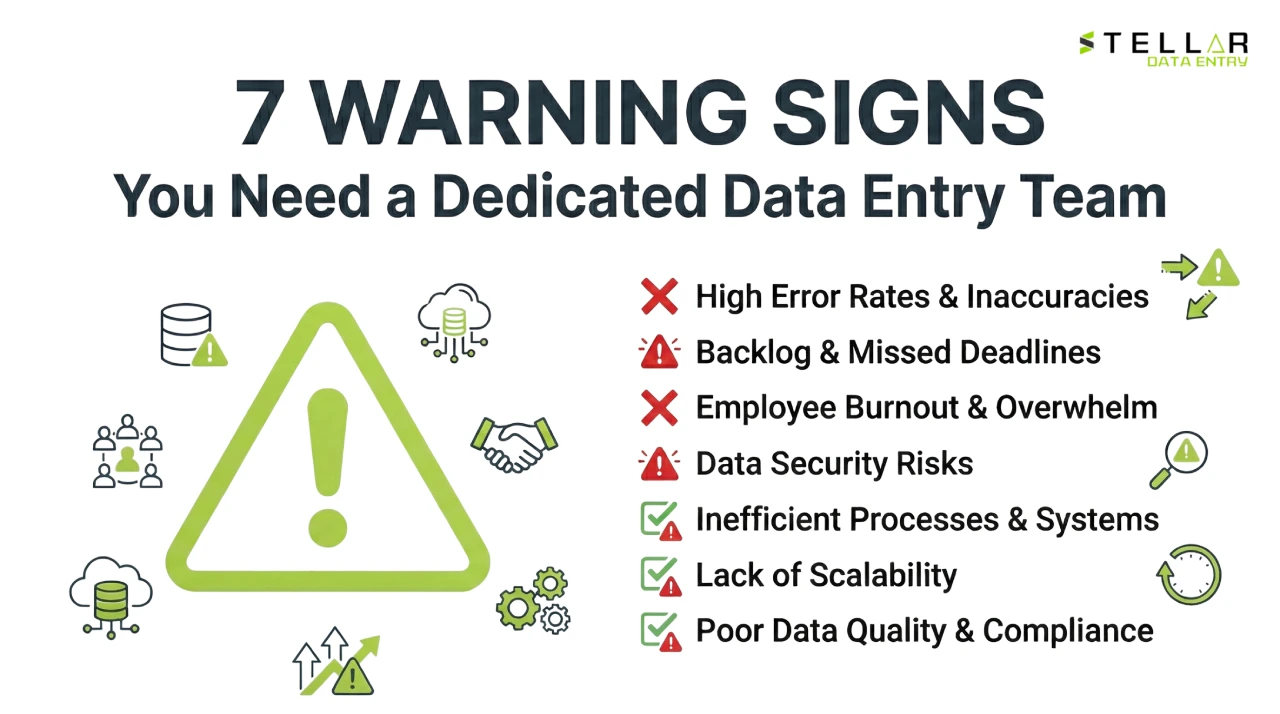
Right, But When Is the Right Time to Outsource?
There’s rarely a single moment where it becomes obvious. More often it’s a slow accumulation of small problems that eventually tips into a real one.
Your Staff Are Spending Serious Time on It
Pull up your team’s actual work breakdown for a week. If the people you hired to manage accounts, drive sales, or run operations are routinely spending hours on data entry, you’re paying for a mismatch. The work isn’t going to stop, but it probably shouldn’t be sitting where it is.
The Quality of Your Records Has Dropped
Wrong contact details. Financial reports that won’t reconcile. Records that contradict each other. These things feel like small irritants until they cause a proper problem, a lost client, a compliance gap, a strategic decision made on figures that turned out to be wrong. By the time you notice the pattern, it’s usually been building for months.
You’ve Got a Project That’s Bigger Than Your Team Can Absorb
System migrations are a classic example. So are database consolidation projects, historical digitisation jobs, end-of-year reconciliations. These come up occasionally, they’re large and finite, and they’re exactly the kind of thing you don’t want to pull your existing team off their actual work to handle. Outsourcing a defined scope is just the practical call.
You’re Growing and the Data Side Hasn’t Kept Up
More customers, more orders, more records. If the data management side of the business hasn’t scaled alongside the growth, the gap widens quickly and gets harder to close. Better to build the right support structure while you’re growing than try to retrofit it when you’re already overwhelmed.
Getting It Wrong Carries Regulatory Risk
Healthcare, finance, legal, logistics. In these sectors, inaccurate records aren’t just an operational headache. They can trigger compliance issues, audits, penalties. If the cost of errors is high enough, the case for a specialist provider basically makes itself.
How to Pick the Right Provider
Not all data entry companies are the same, and once you’re handing over sensitive business records, the differences matter a lot.
Ask for documented accuracy figures. Any decent provider should be able to give you specifics, not just a general claim of being “highly accurate.” Look for 99% or above, backed by an actual verification process, ideally double-keying or an equivalent QA system.
Turnaround time is worth nailing down in writing, including what happens when something is genuinely urgent and the standard timeline isn’t going to work.
On security: confidentiality agreements, encrypted file transfer, clear policies on how data is stored and eventually deleted. If a provider is vague on any of this, keep looking.
Industry experience matters more than people expect. A team that already understands the terminology, compliance expectations and data structures in your sector gets up to speed faster and makes fewer context-related errors. Worth asking specifically what they’ve handled in your space.
And think beyond the current project. Can they handle double the volume in two months if you need them to? The best partnerships are the ones that grow with you rather than maxing out when you need them most.
Stellar Data Entry covers all of the above, trained professionals, rigorous QA, and data handling you can actually trust.
Frequently Asked Questions
What do data entry services actually include?
More than most people expect. Manual input, OCR-based digitisation, data cleansing, format conversion, product catalogues, online form processing, survey data entry, and often a combination of several depending on the project. Worth having a conversation about your specific situation rather than assuming a fixed scope.
What does it cost?
Pricing models vary. Per-record and per-page are common for straightforward input work. Hourly or project-based pricing tends to apply to more complex jobs. In most cases, outsourcing ends up cheaper than a comparable in-house function once you factor in salaries, overheads, software and management time. But you’d want a direct quote for your actual requirements.
Is it secure to send your business data externally?
With the right provider, yes. What you’re looking for: signed NDAs, secure file transfer protocols, documented data handling policies, and controlled access limited to people directly working on your account. If any of those aren’t standard practice for a provider, that’s a red flag.
Who uses these services?
Genuinely across the board. Healthcare, finance, legal, retail, e-commerce, logistics, real estate, education. Any business generating significant record volumes has a practical use case. It’s less about the industry and more about whether the volume justifies it, which for most mid-sized businesses and up, it usually does.
Can providers handle really large volumes?
That’s actually the core advantage of going this route. Professional data entry operations are built specifically for scale in a way that most internal teams aren’t. Millions of records, tight deadlines, high accuracy maintained throughout, these are standard operating conditions for established providers.
Data entry vs. data processing, what’s the difference?
Data entry is the input stage, getting the information into a system. Data processing is everything that follows: verification, transformation, organisation, cleaning, sometimes analysis. Some businesses only need one, most need both. Plenty of providers handle the full picture under one engagement, which is usually simpler than splitting it across two parties.
If data entry is eating into time your team should be spending elsewhere, or the quality of your records isn’t where it needs to be, Stellar Data Entry can help. Get in touch and we’ll talk through what makes sense for your situation.
If your team is carrying data entry work that belongs somewhere else, Stellar Data Entry can take it off your plate. Fast turnaround, documented accuracy, and the confidentiality your business requires. Get in touch to talk through what you need.