
In This Article
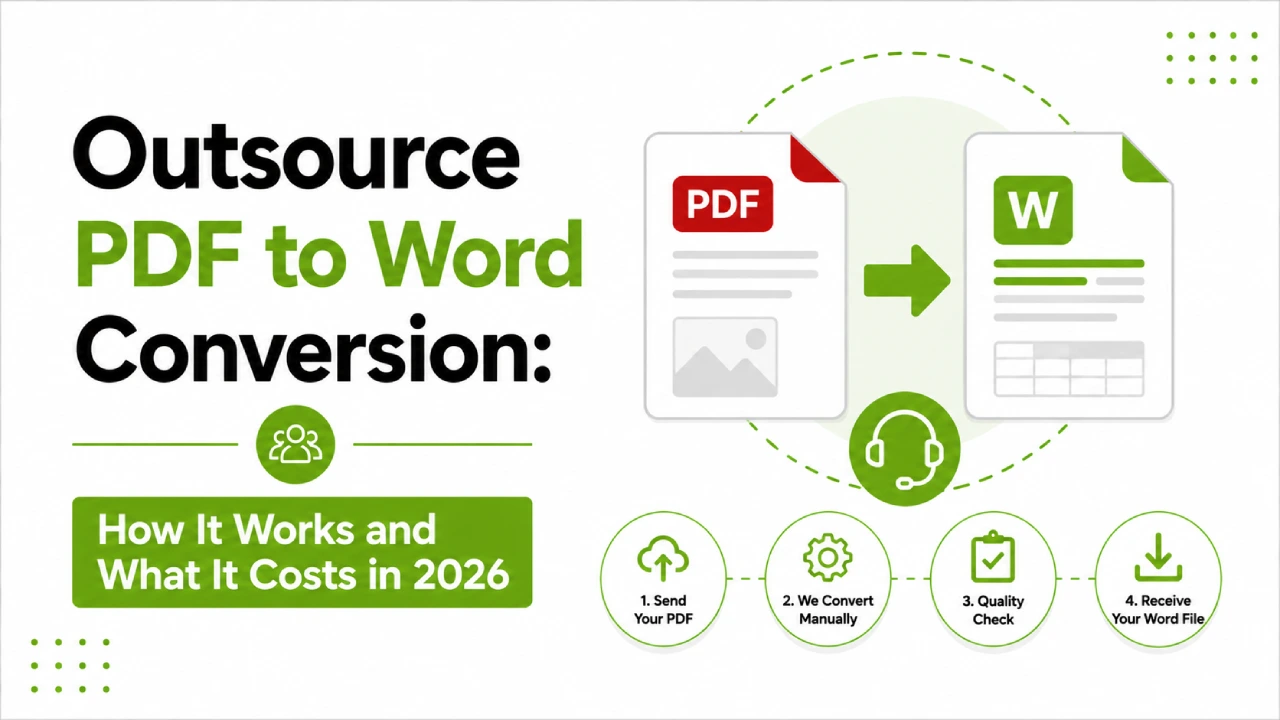
Legal teams deal with this more than most. A contract arrives as a PDF, a brief needs to be edited, historical case files need to become workable documents, and someone in the firm is spending time on conversion work instead of billable work.
Outsourcing PDF to Word conversion is a straightforward operational decision for most law firms and legal process outsourcing companies, but the specifics matter. How the service actually works, what pricing looks like in 2026, and what makes a legal conversion provider different from a general one are all worth understanding before you commit.
Why Legal Teams Outsource This Work
The honest answer is time. Fee-earner hours spent on PDF conversion are fee-earner hours not spent on client work, and most firms can do that calculation fairly quickly.
But the reason legal outsourcing in particular has grown isn’t just cost, it’s specialisation. General conversion tools handle straightforward documents reasonably well. Legal documents aren’t straightforward. Contracts have defined formatting conventions, clause hierarchies, cross-references, and numbering structures that need to survive conversion intact. Court filings have margin specifications and font requirements. Due diligence document sets can run to thousands of pages across hundreds of files, with consistent formatting required throughout. Getting all of that right in Word, at any real volume, isn’t a task you throw at an automated online converter.
LPO firms that handle document management for law firms understand this acutely. The conversion output isn’t just something that needs to look right on screen. It often feeds directly into document management systems, gets edited by multiple people, or goes out to clients and courts. Errors in that output create downstream problems that can take considerably more time to fix than the original conversion took.
How the Outsourced Conversion Process Works
The Initial Review
Professional PDF to Word conversion for legal work doesn’t start by running files through a tool. It starts with a review of what’s in the batch.
Legal documents vary significantly even within the same firm. A five-year contract archive might include documents from multiple word processors, scanned originals, PDFs exported from different systems, and files with varying formatting standards. Before the main work begins, a sample gets reviewed to understand the range present, identify any scanned material that requires OCR, and flag documents with unusual layouts or formatting requirements. That upfront step is what prevents surprises mid-project.
The Actual Conversion Work
For digitally native PDFs — documents created on a computer and saved or exported as PDF — the conversion extracts the underlying text and reconstructs the document structure in Word. This sounds simple and is genuinely reliable when the source document has clean, consistent formatting.
Complex formatting is where manual involvement becomes necessary. Numbered clause structures, defined terms in bold or underlined text, tables within contracts, footnotes, schedules and annexures that carry their own formatting — all of these require someone to check that the structure came through correctly, not just that the text is present. A converted contract where clause numbering has shifted or a defined term has lost its formatting is a problem that can go unnoticed until someone relies on it.
Scanned Legal Documents
A significant portion of legal document conversion projects involve older documents that only exist as physical originals or low-resolution scans. Historical contracts, executed agreements predating digital filing, documents received from opposing parties or courts in scanned form.
These files require OCR processing, and for legal material the accuracy bar is higher than it is for most document types. A misread character in a contract figure, a date that comes through incorrectly, a defined term that gets garbled — all of these have potential legal consequences. Professional conversion services handling legal documents apply human verification to OCR output rather than treating the automated result as final.
Quality Check and Delivery
Before any converted file goes back to the client, it gets checked. Not a spot-check of a percentage of the batch, but verification of the complete output against the source documents. That means page count, structural integrity, formatting accuracy, and in the case of complex documents, a manual review of key sections that are most prone to conversion issues.
The format of delivery is agreed in advance. Some firms need files dropped into a document management system. Others want a structured folder layout. Some need converted files named to a specific convention. These details matter for legal workflows and a professional service accommodates them rather than delivering a flat ZIP file and considering the job done.
What PDF to Word Conversion Costs in 2026
What you actually pay to outsource PDF to Word conversion comes down to what the documents are, how many there are, and how quickly you need them back. Those three variables drive the cost more than anything else, and they interact in ways that make meaningful general pricing difficult to give.
For clean, digitally-native PDFs with straightforward formatting, per-page pricing in 2026 typically falls in a range that makes individual legal document conversion genuinely accessible. Simple contracts, standard correspondence, and uncomplicated briefs sit at the lower end of the pricing scale.
Complex documents, which is most of what legal teams actually need converted, cost more. Multi-part contracts with schedules, heavily formatted court documents, documents requiring clause-level formatting verification — these take longer per page and are priced accordingly. The complexity premium is real, but so is the cost of getting these wrong.
Scanned documents attract a higher rate again because OCR processing and human verification are both involved. Depending on scan quality and document age, scanned legal documents can take considerably longer per page than their digital equivalents.
Volume discounts apply at most professional services from a certain threshold onward. A law firm converting an ongoing stream of documents every month is in a better position to negotiate than one bringing a one-off project. For LPO firms handling document work for multiple law firm clients, volume pricing arrangements tend to make the economics work well.
Rush pricing is worth asking about upfront if your work is deadline-driven, which legal work often is. Most providers offer expedited turnaround for a premium, but the availability and pricing of that option varies significantly.
To get a meaningful quote for your specific documents, send a sample. A provider who quotes without seeing real material is pricing on assumptions, and the actual number will change when they see what you have.
Legal Document Types That Come Up Most
Contracts and Agreements
The most common request. Historic contracts that need to be editable for renegotiation, agreements received from counterparties as PDFs, executed documents where the original Word version was lost. Multi-party agreements with schedules, annexures, and cross-references all need careful handling to preserve the document structure.
Court Documents and Filings
Briefs, pleadings, motions, orders. Court documents have specific formatting requirements, and converted Word files need to meet those requirements as usable source documents, not just as readable text. A professional service familiar with legal filing conventions handles this differently from one that treats all documents as equivalent.
Discovery and Due Diligence Documents
Document review in litigation or M&A contexts can involve converting thousands of pages. The individual conversion challenge on each document might be relatively low, but consistency across the full set matters, and volume without a proper process tends to produce varying output quality across batches.
Deposition Transcripts and Witness Statements
Transcripts that arrive as PDFs, either from court reporters or from other parties in litigation, often need to be in editable Word format for annotation, redaction, or integration into case management systems. Formatting in transcripts, the header structure, the speaker identification, the line numbering, needs to carry across correctly.
What to Check Before Choosing a Provider
Legal document conversion is an area where a weak provider creates genuine risk, not just inconvenience. The questions worth asking before you commit are specific, and the answers tell you a lot.
Start with QA. Ask what the quality check process looks like on complex legal documents specifically, not on standard files. Ask whether their team is familiar with legal formatting conventions and what the remediation process is when a problem surfaces post-delivery. A provider who can walk through this in detail is running a tighter operation than one who answers generally.
Confidentiality is non-negotiable for legal work. Before any client files leave the firm, there needs to be a signed NDA, a clear explanation of access controls during the project, encrypted file transfer, and a documented policy on what happens to both source and output files after the job completes. Law firms dealing with active matters have obligations here that go beyond standard business privacy. A provider who is casual about any of this, or who treats these questions as unusual, isn’t the right choice.
Prior experience with legal document types is worth verifying rather than assuming. A team that regularly processes contracts, court filings, and large discovery sets will have built workflows around those specific document characteristics. One that handles occasional legal work alongside everything else will be approaching your project with less-refined processes and a steeper learning curve.
Stellar Data Entry handles outsourced PDF to Word conversion for legal teams and LPO firms, with dedicated QA on legal documents, full confidentiality agreements, and per-project pricing that reflects the actual complexity of the work. Get a quote based on your documents.
Frequently Asked Questions
How much does it cost to outsource PDF to Word conversion?
Honestly, it varies too much to give a useful single number. Clean, digitally-native PDFs with simple formatting sit at the lower end of the per-page rate. Anything complex, contracts with schedules, court documents with specific formatting requirements, multi-party agreements, takes longer and is priced to reflect that. Scanned documents sit at a higher rate again because OCR and human verification are both part of the process. For legal work specifically, a quote based on your actual sample files will be considerably more accurate than any figure drawn from general pricing guidance.
How do I know my confidential legal documents are safe?
Ask specifically rather than assuming. Before any files leave the firm, you want a signed NDA, confirmation of how transfer is handled, clarity on who within the provider’s organisation can actually access your documents, and a straight answer on what happens to source files after the job is finished. Law firms dealing with active matters carry confidentiality obligations that go beyond standard business privacy. A provider who handles legal work regularly will have clear answers to all of this without hesitation.
Can scanned legal contracts be converted to Word accurately?
Yes, but the quality of the source scan affects the accuracy of the output. High-quality scans of cleanly printed text convert well. Lower-resolution scans, documents with handwritten annotations, heavily formatted documents, or anything with physical damage or unusual print quality require more careful handling and more intensive human review. A professional service will assess scan quality before committing to output accuracy rather than promising a blanket result.
What turnaround time should I expect?
A straightforward legal document project typically runs a few days. Rush options exist at most providers, though availability and pricing vary and it’s worth asking before you’re under deadline pressure rather than after. Large discovery sets and extensive due diligence document batches need a scoped timeline rather than a general estimate, because volume and format complexity drive the number significantly. The main mistake firms make here is agreeing a deadline before the provider has seen what’s actually in the batch.
Is outsourced conversion better than using an online free tool?
For anything a legal team is going to actually rely on, a professional service is the safer choice. Free tools work adequately on plain text but routinely produce broken formatting on complex legal documents, mishandle clause structures and numbering, and have no useful path for correction when the output is wrong. The calculation changes when you’re working with documents that will be edited, filed in court, or sent to clients. The risk of an error making it through is higher than most firms would accept in any other part of their workflow.
Can a provider handle ongoing volume rather than just one-off projects?
Yes, and for LPO firms or legal teams with regular conversion requirements, an ongoing arrangement typically works better than project-by-project engagement. Volume pricing applies, the provider learns your document conventions over time, and the process gets more efficient as both sides understand what to expect. Ask about structured monthly or retainer arrangements if your volume is consistent.
Ready to get a quote on your PDF to Word conversion requirements? Stellar Data Entry provides legal-focused conversion services with full confidentiality, human QA, and pricing based on your actual documents. Get a quote today.