
In This Article
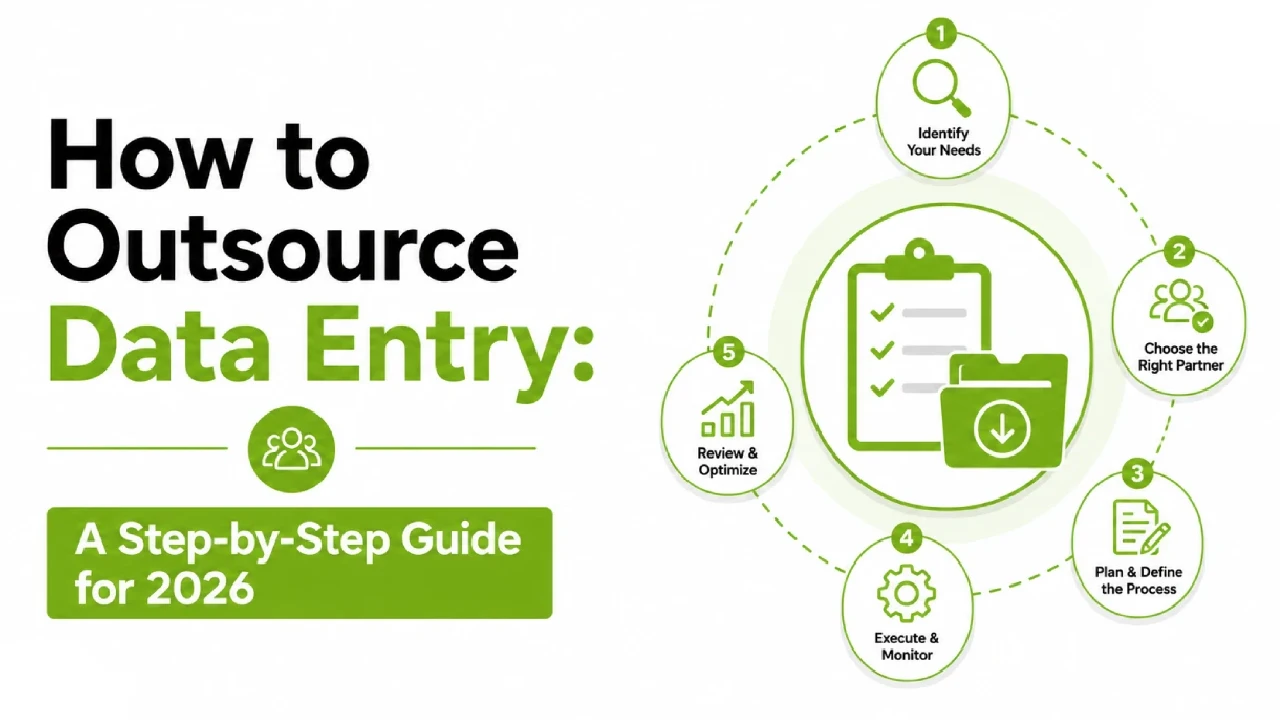
Businesses that wait until they’re overwhelmed before outsourcing data entry usually regret the timing. The backlog is bigger, the errors are harder to untangle, and whoever takes on the project is inheriting a mess rather than a clean handover.
If you’re thinking about it now, that’s the right instinct. This is a practical walkthrough of how to actually do it, in the order that tends to work, with the honest notes on where things usually go wrong.
A Realistic Starting Point
Outsourcing data entry isn’t complicated, but it does require a bit of groundwork before you start contacting providers. The businesses that rush straight to getting quotes almost always end up with mismatched expectations on both sides.
The work you’re describing will mean different things to different providers. “Data entry” as a category covers manual input from physical forms, structured database entry, OCR-based digitisation of scanned files, product catalogue updates, survey processing, CRM population, and more. Some providers are strong across all of these. Others are genuinely built around one or two specific types.
Getting the groundwork done first, even if it takes a few hours, saves a lot of back-and-forth later.
Step 1 – Define the Work Before Anyone Else Does It for You
Write It Down Properly
Not a full formal brief, just a document you could send to any provider and have them understand what they’d actually be doing. Cover the source material — what form is the data coming in? The destination, meaning what system or format does it need to land in? Volume, turnaround expectations, and the accuracy requirements.
That last point is worth sitting with. Different types of data entry carry very different error tolerance. A product listing with a minor formatting inconsistency is annoying. A financial record with an incorrect figure, or a medical document with a data entry error, is a different category of problem entirely. Be honest about which kind of work this is and what the consequences of errors look like in practice.
Include a Sample if You Can
If you have even ten or twenty examples of the actual source files, attach them. Providers who’ve looked at real material will give you a much more useful quote and a more accurate turnaround estimate than one working entirely from a text description.
It also surfaces things you hadn’t thought to mention. Unusual fonts in scanned documents, handwritten sections, inconsistent formatting across a batch – these are the details that affect both pricing and timeline and are very hard to anticipate without seeing the material.
Get Clear on What You Don’t Want to Outsource
Some businesses try to hand everything over at once and end up with a more complex arrangement than they needed. If certain records are too sensitive for an external team, or certain tasks require domain-specific knowledge your provider won’t have, keep those internal. A clean, well-scoped engagement is usually easier to manage and delivers better results than one that’s trying to solve everything at the same time.
Step 2 – Choose the Right Type of Provider
This decision gets less attention than it deserves, and the wrong choice here creates problems that are harder to fix than people expect.
Freelancers can work for time-limited, clearly defined projects. A single person has capacity limits though, and if they’re unavailable or the volume spikes, there’s no backup. Data handling is also typically less formal than with a company, which matters if your files contain anything sensitive.
General BPO firms offer more resource, but data entry is often a small slice of a much broader service portfolio. Quality and attention can vary quite a bit depending on which team picks up your account. It’s worth asking specifically how their data entry work is staffed and reviewed – not just what the brochure says.
Specialist providers, companies where this is genuinely the core business rather than one service among twenty, tend to have tighter QA, faster onboarding, and more refined workflows for the common file types. For anything ongoing, complex, or high-volume, that specialisation tends to show up in the output quality. Stellar Data Entry sits in this category, handling manual input, OCR digitisation, data cleansing, catalogue management and related work across a range of industries.
Step 3 – Vet Carefully, Not Just Quickly
Getting three quotes and picking the middle one isn’t really a vetting process. The conversations you have at this stage reveal far more than the numbers do.
Ask About Quality Control Specifically
Any provider can quote you an accuracy rate. What you want to understand is how that figure is achieved and maintained. Do they use double keying? Is there a dedicated QA review stage? Who catches errors before the file reaches you? A provider who can walk you through their quality process with specifics is running a different kind of operation than one who answers with a percentage and a confident smile.
Data Security Needs a Proper Answer
You’re handing over business records, and in many cases those records contain customer information, financial data, or documentation that’s subject to privacy regulations. So push on this before agreeing to anything. You want to know they sign an NDA as standard. You want to know files move via secure transfer rather than plain email. Clear retention and deletion policies matter too, especially if you’re in a regulated sector. A provider who gets vague on any of this or steers the conversation elsewhere – treat that as information.
References Are Worth Following Up
Most providers list client names or testimonials. Go further than that. Ask for two or three contacts you can actually speak to, preferably from businesses with a similar type of work to yours. A ten-minute call with a reference tells you more than any written testimonial, and a provider who hesitates to offer references is telling you something in that hesitation.
Step 4 – Run a Pilot First
Don’t commit to a full volume engagement before seeing the output. A pilot project is a small investment of time that protects a much larger one.
Take a batch of real files – not the easiest ones you have, but something representative of the actual range – and run them through the provider under normal conditions. Agree on the output format and timeline in advance, then review the results carefully when they come back.
Accuracy is obviously what you’re checking, but communication during the project tells you just as much. Did they flag anything when the source material was unclear, or did they make assumptions and say nothing? The answer gives you a pretty reliable signal of how they’ll behave at scale.
If results are good and the process felt smooth, move forward. If there were problems, discuss them before deciding anything. Some issues point to a fundamental misfit. Others are entirely fixable with a short conversation about expectations.
Step 5 – Set Up the Ongoing Workflow Properly
If the pilot works out and you’re moving into a regular arrangement, how you structure the handover process matters more than most people expect. The businesses that skip this step and just carry on from the pilot usually hit friction within a few months when volumes change or someone new comes onto the account.
Document the Basics
How files come in, what format they’re in, on which schedule. How the output comes back, what it should look like, when to expect it. Who to contact on both sides when something needs clarifying. What happens if source material is ambiguous or a file is corrupted.
None of this needs to be elaborate. A clear document covering these points prevents most of the friction that tends to build up in the first few months of an outsourced arrangement. One page is usually enough.
Build In a Review Point
Set a date, maybe six or eight weeks in, to properly sit with how things are actually going. Not a quick check-in, but a genuine look at accuracy rates, whether turnaround times are holding up, whether the communication has been working well, and whether the scope still reflects what you actually need.
Things shift. Volumes change. The arrangement that made sense in month one often needs some adjustment by month four, and the businesses that build in a review moment tend to catch those gaps before they become real problems. The ones that don’t tend to let things drift until something breaks.
Step 6 — Manage the Output, Not the People
Once the engagement is running, there’s a temptation to stay closely involved. Resist it. A good provider doesn’t need you supervising their process. That’s their job.
What is your job: checking that the output meets the agreed standard on a regular basis. Not vaguely, but with specifics. Flagging issues by being concrete rather than general. “The quality hasn’t been great” is hard to act on. “Seventeen records in the last batch had the date formatted incorrectly” is something they can fix.
A brief monthly check-in, even just by email, keeps things calibrated. Outsourced arrangements are surprisingly prone to drifting into quiet underperformance when neither side is actively paying attention. The check-in isn’t overhead. It’s maintenance.
Where Businesses Commonly Go Wrong
Worth naming a few patterns that come up repeatedly.
Underestimating the scoping phase. When businesses rush past this, providers quote for something different from what was intended and nobody realises until the work is already in progress.
Choosing on price alone. The cheapest provider for simple work might not be the cheapest when you factor in the hours spent reviewing and correcting. Error rates and turnaround reliability are part of the real cost.
Skipping the pilot. It seems like an unnecessary delay when you’re trying to get something sorted quickly. It very rarely is.
Not reviewing the arrangement over time. Outsourcing done well needs periodic attention, not constant supervision. Skipping that periodic attention is how small misalignments become permanent ones.
Frequently Asked Questions
How much does it typically cost to outsource data entry?
Pricing really does vary quite a bit. High-volume manual input is generally priced per record and can be quite cost-effective at scale. Work involving scanned documents, OCR processing, or complex formatting takes longer and costs more. The more useful question is usually what it’s costing you now, counting actual staff time, error correction, and management overhead, compared to what a specialist provider would charge for the same output. Run that calculation honestly and the comparison tends to look different than people expect.
How do I know my data will be handled securely?
Get the specifics in writing before you share anything. A proper NDA, secure file transfer, a documented data handling policy, and controls on who can access your files. These aren’t unusual requests for a reputable provider and shouldn’t be treated as such. If a provider can’t answer clearly or acts like these are difficult questions, take that seriously.
What is the best way to keep quality high over time?
Build the review process in from the start rather than waiting for a problem to surface. Spot-check output regularly, track any errors over time rather than treating each one as isolated, and raise issues with enough specificity that the provider can actually do something about them. A provider who knows their output gets reviewed tends to run a tighter ship than one who doesn’t.
Can sensitive or confidential data be outsourced?
Yes, and it is regularly, across healthcare, finance, legal and other sectors. What matters is that the right agreements and access controls are in place. The confidentiality framework needs to match the sensitivity of the data, not just be a standard template the provider uses for everything.
How long does it take for outsourced data entry to run smoothly?
Most engagements settle into a rhythm within four to six weeks, sometimes faster if the scope was well defined at the start. Rushing to full volume before the workflow is properly set up is one of the most reliable ways to stretch that timeline out.
What should I do if quality drops after a good start?
It happens, and it’s usually fixable. Raise it directly with specific examples rather than a general complaint, ask what changed, and give the provider a chance to respond properly. If quality drops and stays down after a genuine attempt to address it, that’s when you start looking at alternatives.
Ready to get started? Stellar Data Entry handles outsourced data entry for businesses of all sizes, from one-off projects to ongoing high-volume work. Get in touch and we’ll talk through what makes sense for your situation.